Mini Split Installation in Wilmington, DE
A new system here will heat from October through April and cool from June through September every year. Tell us about the house, and a licensed contractor who covers New Castle County will get in touch.
Tell us about the job
It takes about a minute.
What a mini-split in New Castle County has to handle
Your mini-split will run most of the year here, 11 months out of 12 between the heat and the cold. Winter nights average 27°F from December through February, and that's the range where a heat pump has to work to keep pulling warmth from outside air. Summer afternoons average 85°F, so the same unit switches to cooling for four straight months, June through September.
A new mini-split installed today has to meet 14.3 SEER2 for cooling and 7.5 HSPF2 for heating, the federal minimum for split-system heat pumps. New Castle County has also seen its share of winter storms and wind, 11 winter storms and 228 damaging wind events over the past ten years. Worth asking your contractor how the unit and its outdoor placement hold up when the power flickers or the wind picks up.
- 7 months
- October through April, your system heats
- 4 months
- June through September, it cools
- 27°F
- the average winter night it heats against
- 85°F
- the average summer afternoon it cools against
NOAA nClimDiv, 1991–2020 normals
Delaware requires HVAC contractors to hold a state license.
Delaware licenses HVAC contractors through the Board of Plumbing, Heating, Ventilation, Air Conditioning and Refrigeration Examiners. The board tests and records the contractor, not the job, so the license tells you the person or company doing the work has met the state's standard. It does not mean this particular mini-split installation was checked off in advance.
That check comes after the fact, from the local building office. Most cities and counties in Delaware require a permit for a mini-split installation and an inspection once the work is done, and that inspection is what confirms the finished job meets code.
Sources: Delaware Code Online · Delaware Division of Professional Regulation
- Is a mini split worth it?
- For the right setup, yes. A mini split puts heat exactly where you need it without ducts, and the outdoor unit still works as a heat pump down into cold weather, which matters here with winter nights averaging 27°F from December through February. It also covers the four months of cooling from June through September. Whether it makes sense for your house depends on how it's heated now and which rooms need help, so a contractor should walk through that with you before you decide.
- How many rooms can a mini split cover?
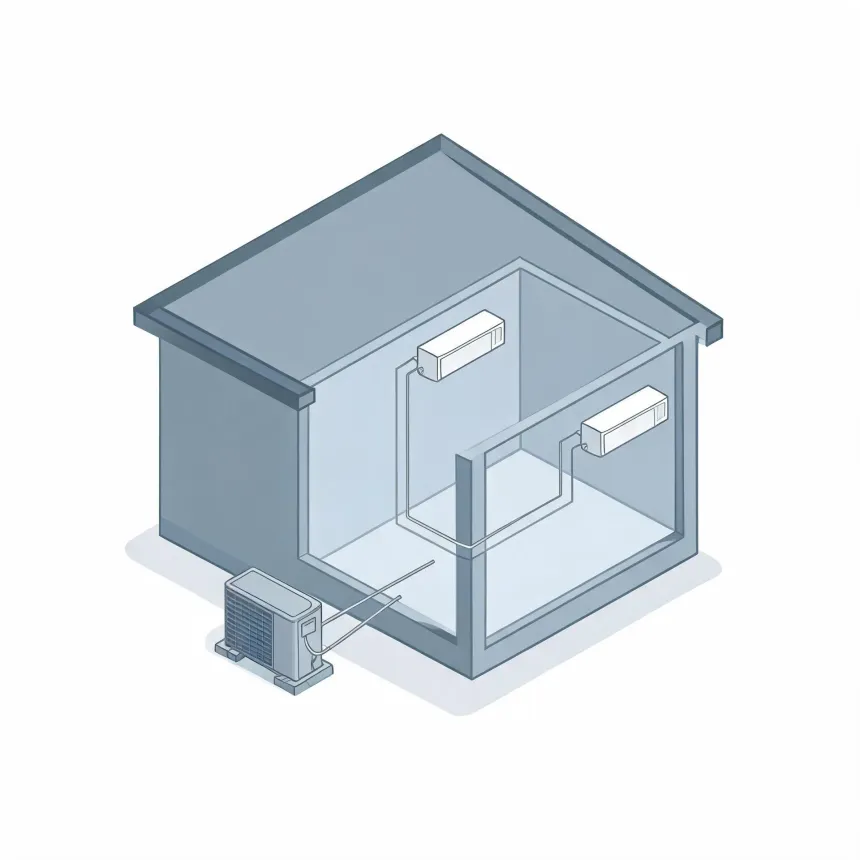
- One outdoor unit can run several indoor heads, so it can cover more than one room. Each indoor head is placed in the room or open area it serves, and the outdoor unit has to be sized to carry all of them at once. A contractor will look at how many rooms you want covered and size the system to match.
- Can a mini split heat a whole house?
- It can, if the system is sized and placed for the whole house rather than a room or two. That means an indoor head in each area that needs heat, and an outdoor unit sized to carry all of them through the coldest nights, which here drop to an average of 27°F from December through February. More than half the homes in this area heat with gas, so switching a whole house to mini splits is a bigger decision than adding one to a single room. A contractor can look at your house and tell you what it would take.